

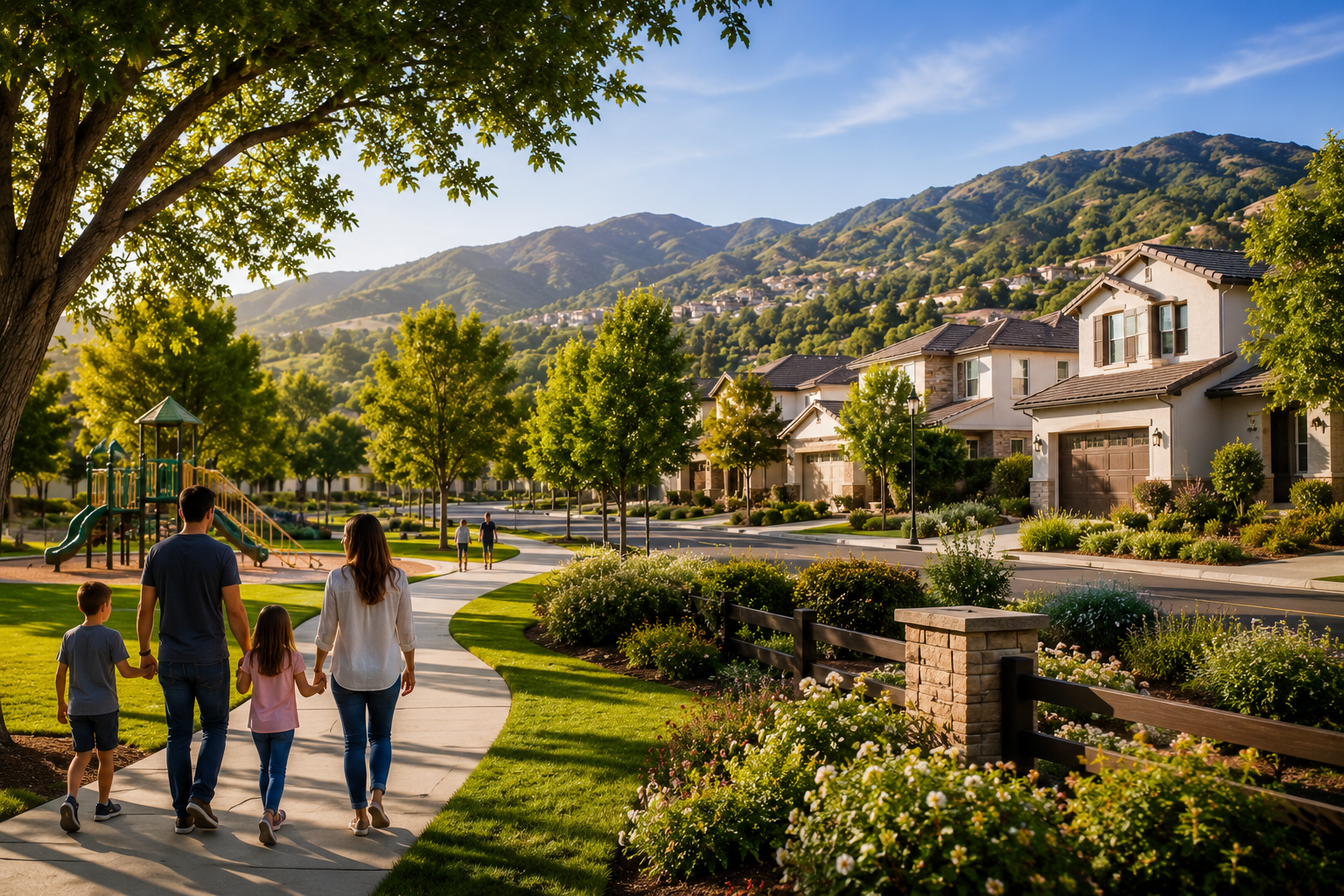
Thousand Oaks consistently ranks among the safer, more park-rich cities in Southern California, which draws families in from across the region. But the city covers a lot of ground, and the neighborhoods within it are not interchangeable. A family prioritizing school assignment will land somewhere different than one looking for a large lot, and a relocating family flying in for a weekend of tours needs a different kind of map than someone already familiar with the Conejo Valley.
This is a neighborhood-by-neighborhood breakdown of where families tend to concentrate in Thousand Oaks, and what drives each area's appeal. If you are working with a real estate agency in Thousand Oaks, this is the kind of local detail that should be part of every conversation from the start.
What Makes a Thousand Oaks Neighborhood Right for a Family
Most families entering this market are weighing four things against each other: school assignment, lot size, commute access, and price. Thousand Oaks does well on all four in general terms, but the tradeoffs between neighborhoods are real and worth understanding before narrowing a search.
Almost all of Thousand Oaks falls within the Conejo Valley Unified School District, which is a significant draw for families with school-age children. The exception is Lang Ranch, which feeds into Westlake High School through the Las Virgenes Unified School District. That single distinction reshapes the demand profile of an entire pocket of the city, and it explains why Lang Ranch commands a premium that surprises buyers who do not yet understand district lines.
Lot size and home age vary considerably across neighborhoods. The western side of the city, including Wildwood and Lynn Ranch, tends to offer larger parcels and older ranch-style construction. The eastern and newer areas, including Lang Ranch and Rancho Conejo, offer more recent builds with HOA-managed landscaping and community amenities. Neither profile is universally better, but they attract meaningfully different types of buyers.
Community feel matters too. Some neighborhoods have active youth sports cultures centered on specific parks and fields. Others are quieter and more residential in character. The breakdown below covers both the real estate specifics and the daily-life context that family buyers are actually weighing.
Lang Ranch: The School-Priority Pick
Lang Ranch is the only pocket of Thousand Oaks that feeds into Westlake High School, making it a consistent target for families who have already done their research on district lines. Most of Thousand Oaks feeds Thousand Oaks High School or Newbury Park High School through Conejo Valley Unified. Lang Ranch sits within Las Virgenes Unified, which means the elementary school feeder is Lang Ranch Elementary and the high school destination is Westlake High School rather than the Conejo Valley Unified secondaries.
The housing stock here runs from the late 1980s through the early 2000s, with several gated subsections including Meadowwood, Woodridge, and Verdigris. Newer construction by Thousand Oaks standards, well-maintained streetscapes, and HOA management give the area a turnkey quality that appeals to relocating families who do not have time to renovate. Lang Ranch Sports Park is within the neighborhood and serves as a hub for youth sports activity in the area.
The premium in Lang Ranch reflects the school assignment more than the homes themselves. Buyers who compare square footage across the city sometimes find better value elsewhere, but for families with a specific commitment to Las Virgenes Unified, this neighborhood is the primary option within Thousand Oaks city limits.
Wildwood: The Outdoor-Access Pick
Wildwood sits on the western edge of Thousand Oaks and backs up directly to Wildwood Regional Park, one of the more significant open space areas in the Conejo Valley. The park connects to the Paradise Falls trail, a popular destination for families with younger children. For families who value daily outdoor access without driving to a trailhead, the location is genuinely hard to replicate elsewhere in the city.
The homes here are older, predominantly built in the 1970s and 1980s, and there is no HOA governing most of the neighborhood. That means more flexibility for homeowners but also more variation in how properties are maintained. Prices tend to run lower than comparable square footage in newer areas, which makes Wildwood one of the more accessible entry points for families buying in Thousand Oaks for the first time.
Wildwood Elementary serves the neighborhood and feeds into the Conejo Valley Unified system, with students continuing to Thousand Oaks High School for secondary. Families who choose Wildwood are generally making a deliberate tradeoff: older homes and modest lot sizes in exchange for immediate park access and a lower price point than the eastern neighborhoods.
Lynn Ranch: The Larger-Lot Character Pick
Lynn Ranch is one of the few areas in Thousand Oaks where custom homes on large lots remain the norm rather than the exception. The neighborhood developed primarily in the 1950s through the 1970s, and many properties sit on half-acre or larger parcels. Equestrian-friendly lots are not uncommon, and the overall character of the area is closer to a rural residential community than a standard suburban tract.
Families who come to Lynn Ranch are usually prioritizing space, privacy, and a different pace than the HOA-managed neighborhoods elsewhere in the city. The homes are not new, and buyers typically expect to invest in updates. But the lot sizes and the character of the neighborhood are difficult to find at any price in most of Southern California, which keeps demand consistent among buyers who know what they are looking for.
The neighborhood falls within Conejo Valley Unified, with students feeding toward Thousand Oaks High School. The community feel is quieter than more densely built areas, which suits families with older children or those who value space over proximity to organized amenities.
Conejo Oaks: East-Side Custom Homes
Conejo Oaks occupies the eastern side of Thousand Oaks and shares some of the larger-lot, custom-home character of Lynn Ranch, though the two neighborhoods have distinct identities. Properties here tend to sit on generous parcels with mature landscaping, and the construction spans several decades, giving the area a more established feel than the planned communities built later in the city's development.
Families drawn to Conejo Oaks are typically looking for space without the rural character of Lynn Ranch. The neighborhood is more centrally accessible while still offering the kind of lot size that has become genuinely rare in the broader Los Angeles and Ventura County market. It feeds into Conejo Valley Unified, with the same secondary school structure as most of the city.
Sunset Hills: Central Location with Community Proximity
Sunset Hills sits in a central part of Thousand Oaks and is notable for its proximity to Sunset Hills Country Club, which draws families who want access to golf, tennis, and recreational amenities within the neighborhood's footprint. The area offers a mix of home sizes and ages, and its central position makes commuting across the city relatively manageable.
For families where one or both parents commute toward the 101 or into the San Fernando Valley, the central location is a practical advantage. Schools fall within Conejo Valley Unified, consistent with most of the city. The neighborhood tends to attract families who want a balance of community amenities and accessibility without committing to the more defined character of Lang Ranch or Wildwood.
Dos Vientos Ranch: Newbury Park's Family-Focused Master Plan
Dos Vientos Ranch sits within Newbury Park rather than Thousand Oaks proper, but it belongs in any honest family neighborhood guide for this part of the Conejo Valley. It is a master-planned community developed primarily in the late 1990s and early 2000s, with newer construction, well-maintained common areas, and a layout designed around family use.
The school pipeline runs through Conejo Valley Unified toward Newbury Park High School. One school worth knowing specifically is Sycamore Canyon School, a K-8 campus in Newbury Park that serves part of this area and draws consistent interest from families who prefer the K-8 model over a traditional elementary-to-middle split. The community has a distinct neighborhood identity with active parks and recreational spaces built into its planning.
For buyers whose geographic requirement is "Conejo Valley" rather than specifically Thousand Oaks city limits, Dos Vientos Ranch is worth including in any family-focused search.
Rancho Conejo: Guard-Gated and Turnkey
Rancho Conejo is a guard-gated community that draws a consistent share of relocating families, particularly those coming from markets where gated communities are the norm and who want a similar setup in the Conejo Valley. The community is well-maintained, HOA-managed, and offers the kind of turnkey environment that works well for families arriving on a compressed timeline.
The homes are newer relative to much of Thousand Oaks, and the community amenities are oriented around family use. It is a popular landing spot for families tied to Amgen, Baxter, or other major Conejo Valley employers who need to be in a home quickly and want a low-maintenance environment while they get settled. Ross Realty Group works regularly with relocating families in this part of the market, where understanding community rules and HOA structure is as important as the home itself.
How School District Lines Change the Picture
The practical summary is this: almost all of Thousand Oaks falls within Conejo Valley Unified, which serves the city with Thousand Oaks High School and Newbury Park High School as the primary secondary options depending on location. Lang Ranch is the single exception, falling within Las Virgenes Unified and feeding Westlake High School. That distinction drives a measurable price premium in Lang Ranch and creates a search segment that largely does not overlap with the rest of the city.
For families moving from areas with more straightforward district boundaries, the Thousand Oaks picture requires a bit more attention. Elementary assignments within Conejo Valley Unified vary by street, and the Conejo Valley Unified School District publishes boundary tools that allow address-level lookup. Verifying the actual school assignment for any specific property before making an offer is a basic step that experienced agents in this market build into the process automatically.
Ratings and reputation aside, the practical question is always which school a specific address feeds, not which school the neighborhood is generally associated with. Boundaries shift, and relying on general neighborhood reputation rather than confirmed assignment is a common source of disappointment for buyers who did not verify early enough.
Beyond Schools: Parks, Sports, and Community Infrastructure
Thousand Oaks has invested heavily in its park system, and families with active children will find the infrastructure meaningful. Borchard Community Park is one of the most used family facilities in the city, with sports fields, playgrounds, and community event space. Conejo Creek Park offers a different character, with open lawn areas and creek-adjacent trails that work well for younger children. Rancho Sierra Vista provides trail access into the Santa Monica Mountains National Recreation Area, connecting families to longer hikes than the in-city trail systems.
Youth sports infrastructure is genuinely strong here. CVYSL covers soccer for much of the valley, AYSO Region 4 operates across the area, Oaks FC Youth serves competitive-level players, and Conejo Valley Little League has active divisions across age groups. For families where youth sports are a significant part of weekly life, the Conejo Valley's organized sports culture is one of the practical quality-of-life advantages that does not always show up in city ranking articles but matters considerably in day-to-day terms.
How Priorities Shift the Search
Different families land in different neighborhoods for good reasons. A family whose primary filter is school assignment in Las Virgenes Unified will look almost exclusively at Lang Ranch. A family prioritizing lot size and outdoor character will spend most of their time in Lynn Ranch or Conejo Oaks. A family focused on outdoor access and a lower entry price will find Wildwood worth serious attention. A relocating family on a compressed timeline with a preference for HOA management will often end up in Rancho Conejo or Dos Vientos Ranch.
None of these is the wrong answer. The Conejo Valley has enough variety that most family priorities can be matched to a real neighborhood with real inventory, once the search is organized around the right criteria. The families who have the hardest time are usually those who have not yet identified which factor matters most, because Thousand Oaks does several things well simultaneously and it is easy to chase all of them at once without landing anywhere.
Working with an agency that knows which neighborhoods actually deliver on each priority, based on recent transactions rather than general reputation, is the practical way to shorten that process. Ross Realty Group works across these neighborhoods with family buyers regularly, and the difference between a search organized around confirmed school assignments and park proximity versus one built on general area impressions is significant.
Want to explore other areas? Go here ;)
Check out this article next