


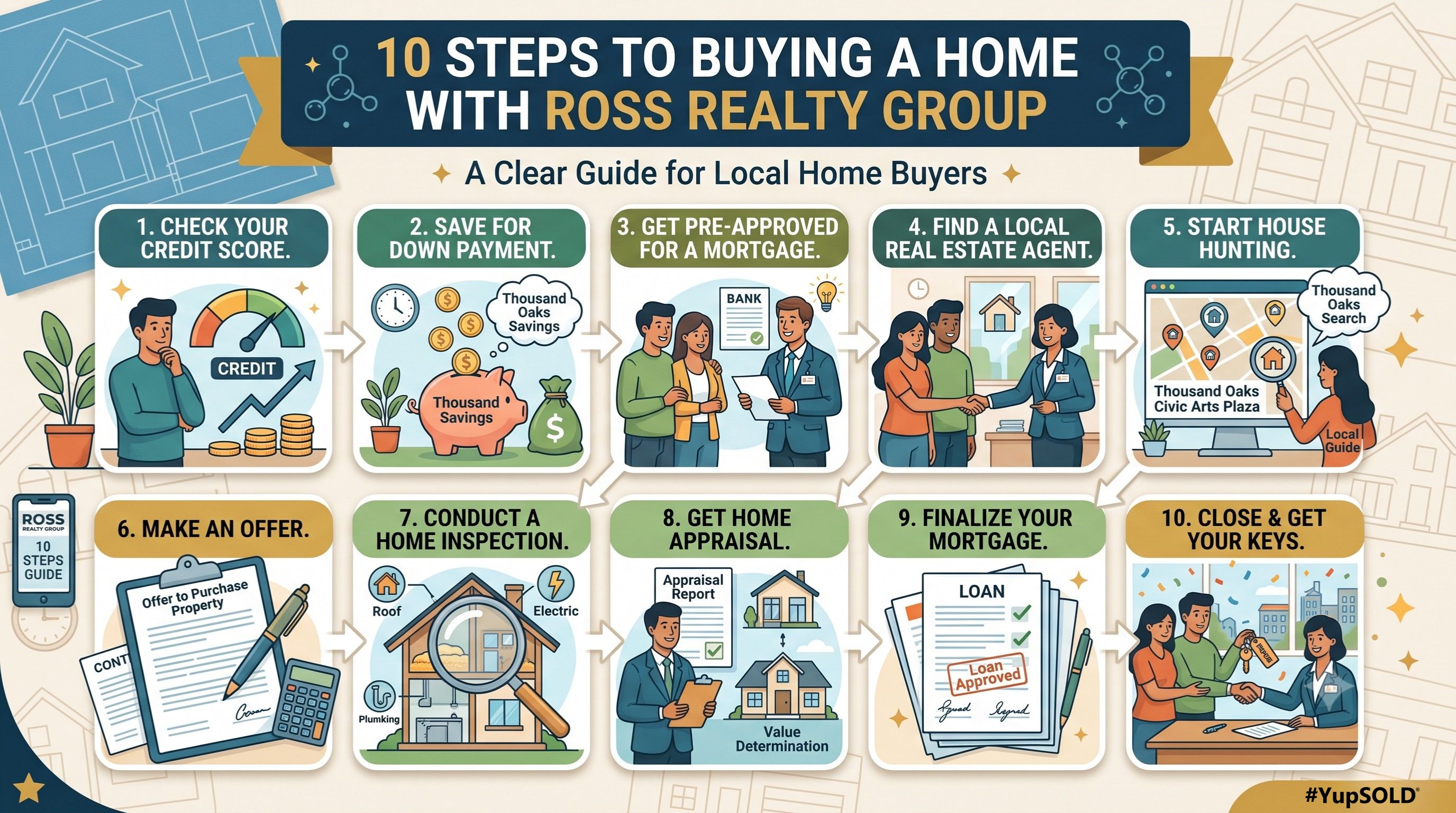
Your Complete First-Time Home Buyer Guide
A step-by-step roadmap for buying your first home in Los Angeles & Ventura Counties — no jargon, no overwhelm. Just a clear path from where you are today to keys in hand.
Buying Your First Home Is a Big Deal.
Southern California prices and competition can feel overwhelming. We get it. But here's the thing — most first-time buyers are closer to purchasing than they think. They just need a clear path.
Eric and Debra Ross have guided hundreds of first-time buyers through this exact process in Ventura and LA County. This guide is built on that real-world experience — not textbook theory.
Ready to take the first step? We're one call away.
Let's Talk →The Truth About Buying Your First Home
Most buyers wait because they think they're not ready. But the cost of waiting — missed equity, rising rents, continued inflation — often outweighs the risk of buying imperfectly. The best time to buy is when you're financially ready, not when the market is "perfect."
Check Your Finances
Before you look at a single listing, you need an honest picture of where you stand financially. This isn't about being perfect — it's about knowing your starting line so we can map the fastest route to homeownership.
Credit Score
- Conventional loans typically need 620+
- FHA loans: as low as 580 (with 3.5% down)
- VA loans: no official minimum
- Higher score = better interest rate
- Check all 3 bureaus for errors — they're common
Debt-to-Income Ratio (DTI)
- Most lenders want DTI under 43%
- Front-end (housing costs alone): under 28%
- Back-end (all debts): under 43%
- Pay down credit cards before applying
- Don't open new credit before buying
Savings
- Down payment: 3–20% of purchase price
- Closing costs: typically 2–3% of loan
- Emergency reserve: 3–6 months expenses
- HOA reserves (if applicable)
- Moving costs & initial home expenses
Income Stability
- Most lenders want 2 years steady employment
- W-2 employees: 2 recent pay stubs + W-2s
- Self-employed: 2 years tax returns
- Job changes in same field usually OK
- Gaps in employment need explanation
💰 Local Cost Example: $750K Home in Ventura County
FHA down payment (3.5%): ~$26,250 · Conventional (5%): ~$37,500 · Closing costs: ~$15,000–$22,500 · Total to close (FHA): approximately $41,000–$49,000
Pull your free credit reports at annualcreditreport.com. Errors appear on 1 in 5 reports and can drop your score 20–100 points. Dispute errors now — don't wait until you're in escrow.
Get Pre-Approved
Pre-approval is your golden ticket in Southern California's competitive market. It's not just a formality — it tells sellers you're serious, qualified, and ready. Without it, most listing agents won't even present your offer.
Pre-Qualification vs. Pre-Approval: Know the Difference
Pre-qualification is a rough estimate based on self-reported numbers — worth little in a competitive market. Pre-approval means the lender has reviewed your documents and officially confirmed your borrowing power. Always get pre-approved.
Documents You'll Need
- 2 years of W-2s or tax returns
- 2 recent pay stubs
- 2–3 months bank statements
- Government-issued ID
- Social Security number
- Landlord contact (for rental history)
Loan Programs to Know
- Conventional: 3–20% down, 620+ credit
- FHA: 3.5% down, 580+ credit
- VA: 0% down (military/veterans)
- CalHFA: Down payment assistance for CA buyers
- Jumbo: For homes over $806,500 (2025 limit)
| Loan Type | Min. Down | Min. Credit | Best For |
|---|---|---|---|
| Conventional | 3–5% | 620+ | Good credit, stable income |
| FHA | 3.5% | 580+ | Lower credit, first-timers |
| VA | 0% | No min. | Active military & veterans |
| CalHFA | 3–3.5% | 660+ | CA buyers needing assistance |
Shop multiple lenders within 45 days — all mortgage inquiries in that window count as ONE credit pull. Even a 0.25% difference in rate saves tens of thousands over a 30-year loan.
Choose the Right Agent
Here's something most people don't know: as a buyer, you typically don't pay your agent's commission. The seller covers it. So choosing the best possible agent costs you nothing extra — and the wrong agent can cost you everything.
What to Look For
- Deep local market knowledge
- Full-time (not a side hustle)
- Verified Google reviews (check them!)
- Strong negotiation track record
- Proactive communication style
- Access to off-market listings
Red Flags to Avoid
- Pressure tactics to make fast decisions
- Dual agency (representing both sides)
- Vague answers about their experience
- Poor communication or slow responses
- No recent sales in your target area
- Discouraging inspections or contingencies
📋 New Rule as of August 2024 (NAR Settlement)
Buyers are now required to sign a Buyer Representation Agreement before touring homes. This document outlines how your agent is compensated. Ask questions — a great agent will explain it clearly and never make you feel pressured.
"How many buyers did you help close last year?" · "What's your strategy in a multiple-offer situation?" · "How will you communicate with me throughout the process?" · "Can I speak with a past client?"
Define Your Wish List
Before you fall in love with a house on Zillow, get clear on what actually matters to your life. The best buyers separate non-negotiables from nice-to-haves — and stay disciplined when emotion takes over.
Must-Haves (Non-Negotiables)
- Number of bedrooms & bathrooms
- School district (check GreatSchools.org)
- Maximum commute time
- Neighborhood safety & feel
- Budget ceiling (stick to it!)
- Single-story vs. multi-level
Nice-to-Haves (Flexible)
- Pool or backyard size
- Garage (1 vs. 2 car)
- Updated kitchen or bathrooms
- Specific street or neighborhood
- Home office or flex space
- HOA vs. no HOA preference
Communities We Know Best
Search for Homes
The best homes often sell before most buyers even see them. Our clients get first access to off-market properties and MLS alerts the moment new listings hit — giving you an edge that Zillow simply can't match.
How We Find Your Home
- Real-time MLS alerts for your exact criteria
- Off-market & coming-soon access
- Agent network for pocket listings
- Expired listing outreach
- New construction & builder access
Smart Showing Strategy
- Tour neighborhoods at different times of day
- Take photos and notes at every showing
- Look past staging — focus on bones & layout
- Check traffic during your commute hours
- Most buyers tour 8–12 homes before deciding
Never post about a home on social media before your offer is accepted — or even discussed with your agent. Sellers can see your posts. It reveals your level of interest and can be used against you in negotiations.
Make a Winning Offer
In Southern California, you rarely buy a home at list price. You win it. Crafting a strong offer is part strategy, part psychology — and this is where an experienced agent makes a massive difference.
Offer Components
- Purchase price — based on comps, not emotion
- Earnest money deposit — typically 1–3% of price
- Contingencies — your protection clauses
- Closing timeline — typically 30 days in CA
- Seller concessions — closing cost credits
The 3 Main Contingencies
- Inspection contingency — right to inspect & negotiate
- Loan contingency — protection if financing falls through
- Appraisal contingency — protection if home appraises low
- Never waive all contingencies without a strategy
🏆 Multiple Offer Strategies
Escalation clauses · Clean terms with fewer contingencies · Larger earnest money deposit · Seller rent-back option · Personal letter (where legal) · Faster close date · All-cash proof if applicable
Inspections & Due Diligence
Your offer was accepted. Now comes the most important 17 days of the transaction. This is your chance to fully understand the property before you commit. Don't rush it. Don't skip it.
Inspections to Order
- General home inspection — always required
- Pest/termite report — especially in SoCal
- Sewer scope — older homes, especially pre-1980
- Roof inspection — if general inspector flags it
- Pool inspection (if applicable)
- Mold/environmental — if visible signs
Seller Disclosures to Review
- Transfer Disclosure Statement (TDS)
- Natural Hazard Disclosure (NHD)
- Fire Hazard Severity Zone designation
- HOA documents (CC&Rs, financials, minutes)
- Permit history
- Neighborhood noise or flight path disclosures
🔥 Fire Hazard Zone Warning — Read This
Many Ventura and LA County homes fall in High or Very High Fire Hazard Severity Zones. This can significantly raise or eliminate homeowners insurance options. Always confirm insurance availability and cost BEFORE removing contingencies. We'll walk you through this.
1. Request repairs from seller · 2. Request a credit toward closing costs · 3. Accept the property as-is · 4. Cancel within the contingency period with full deposit refund
Close Escrow & Get Your Keys
The finish line is in sight. The last stretch requires careful attention — a few mistakes here can delay or even jeopardize your closing. Stay the course, and we'll guide you every step of the way.
Final Loan Approval
- Don't make big purchases (car, furniture, etc.)
- Don't open or close any credit accounts
- Don't change jobs
- Review Closing Disclosure 3+ days before close
- Confirm wire transfer instructions with escrow
Closing Day Checklist
- Final walkthrough (verify condition matches contract)
- Sign loan documents with notary
- Wire funds to escrow (verify the number first!)
- Lender releases funds to escrow
- Title records — you're a homeowner! 🏠
💸 What to Expect in Closing Costs (CA)
Typically 2–3% of the loan amount. Includes: lender fees, title insurance, escrow fees, recording fees, prepaid property taxes, homeowners insurance. On a $750K home: approximately $15,000–$22,500
Hackers intercept escrow email instructions and redirect your wire transfer. Always call your escrow officer directly to verbally confirm wire instructions before sending ANY funds. Never trust an email alone.
✅ Post-Closing To-Do List
Change all locks · Set up utilities · File for Homestead Exemption (saves on property taxes) · Update your address with USPS, bank, DMV · Document every room for insurance purposes · Schedule an HVAC service
Why Buyers Choose Ross Realty Group
Over 348 families helped. Real results. Real reviews.
First-Time Buyer Glossary
Real estate terms in plain English — because you shouldn't need a law degree to buy a home.
Pre-Approval
A lender's formal confirmation of how much they're willing to lend you, based on verified income, credit, and assets. The gold standard before house hunting.
Earnest Money Deposit (EMD)
A good-faith deposit (typically 1–3%) paid after offer acceptance. It goes toward your down payment and signals you're serious. You get it back if you cancel within contingency periods.
Escrow
A neutral third party that holds money and documents during the transaction. In California, escrow companies manage the entire closing process — typically 30 days.
Contingency
A condition that must be met for the sale to proceed. Common contingencies: inspection, loan, and appraisal. They protect you and allow you to exit with your deposit if something goes wrong.
Appraisal
A licensed appraiser's independent estimate of the home's market value. Your lender requires it. If the home appraises below the offer price, you may need to renegotiate.
Title Insurance
Protects you and your lender against claims on the property's ownership (like unpaid liens or disputes). Required by lenders. There are two types: lender's policy and owner's policy.
PMI (Private Mortgage Insurance)
Required when you put less than 20% down on a conventional loan. Typically 0.5–1.5% of the loan annually. Once you hit 20% equity, you can request it removed.
Debt-to-Income Ratio (DTI)
Your total monthly debt payments divided by gross monthly income. Lenders use this to gauge your ability to repay. Most want under 43% (back-end DTI).
HOA (Homeowners Association)
An organization that manages shared spaces in a community. HOAs charge monthly or annual dues and set rules. Review CC&Rs and financials carefully before buying in an HOA community.
MLS (Multiple Listing Service)
The database where agents list properties for sale. The public sees a subset on Zillow and Realtor.com — your agent sees everything, including agent remarks and days on market.
Closing Costs
Fees paid at closing beyond the down payment. Includes lender fees, title, escrow, recording, and prepaid costs. Typically 2–3% of the loan amount in California.
Comparables (Comps)
Recently sold homes similar to the one you're buying, used to determine fair market value. Your agent analyzes comps to help you write a strategic offer — not a guesswork price.
First-Time Buyer FAQ
The questions we hear every week — answered honestly.
What Our Buyers Say
Real stories from real people we helped get into their first homes.
"Eric and Debra were incredible throughout our entire first home purchase. They explained everything, were always available, and fought hard to get us the best deal. We couldn't have done it without them."
"We were so nervous going in as first-time buyers. Eric answered every question patiently and never made us feel rushed. His negotiation skills saved us thousands. Highly recommend!"
"From our first call to the day we got our keys, the Ross Realty team was responsive, knowledgeable, and genuinely cared about finding us the right home — not just any home."
"I didn't think I was ready to buy. Eric showed me I was closer than I thought. Six months later, I closed on my dream home. Life-changing doesn't even cover it."
Our Service Areas
We know these communities deeply — schools, neighborhoods, market trends, and all.
More Resources for You
Ready to Buy Your First Home?
Stop wondering if you're ready. Let's look at your situation together — no pressure, no obligation. Just a real conversation about what's possible for you right now.
Our stats
Experience Matters
top
%
of agents in the US
Star
Rated
⭐⭐⭐⭐⭐
Over
+
Family's Served
Over
$
M
Sales Volume
In the Words of our Clients
Success Stories